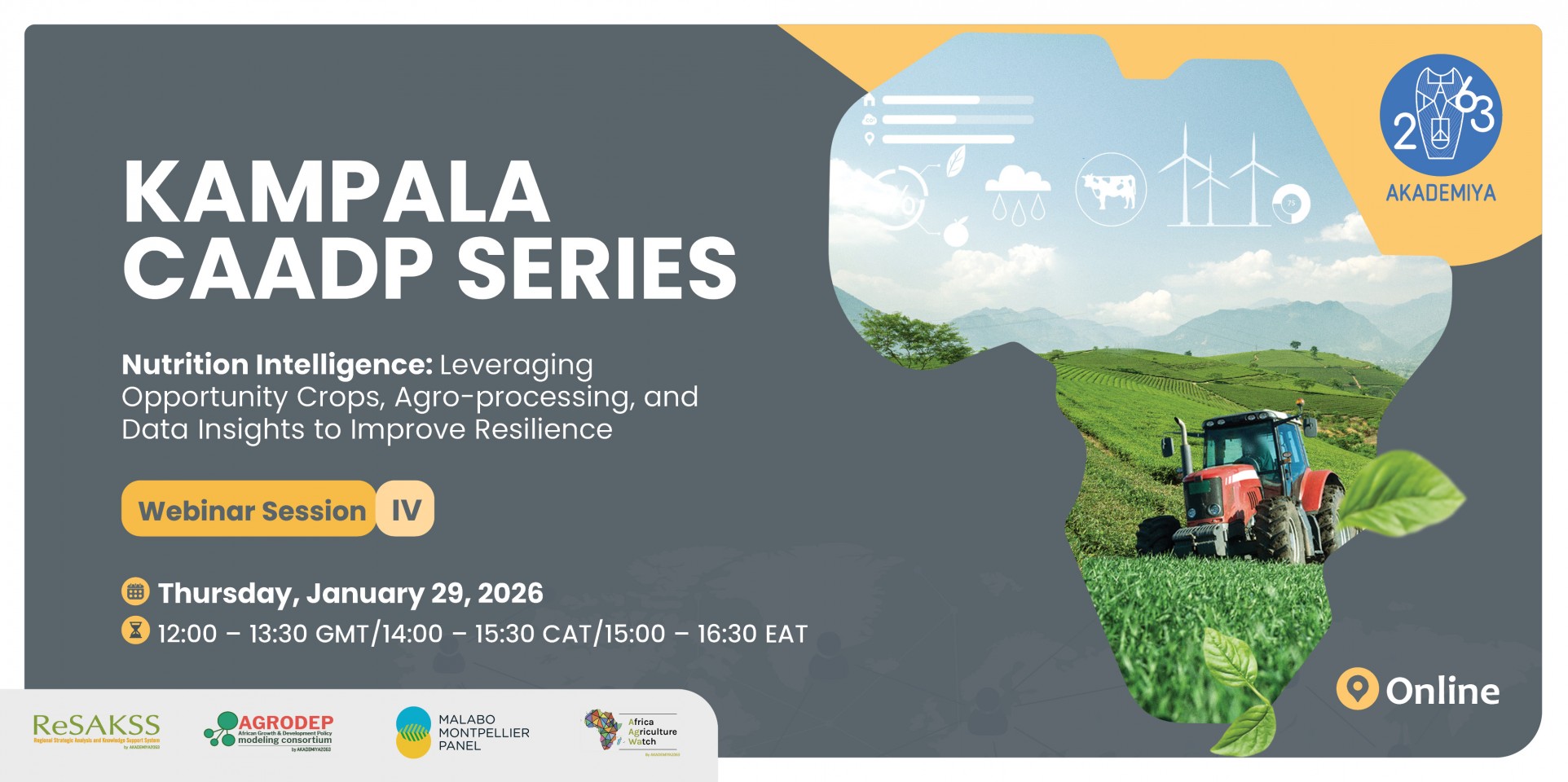
"Nutrition Intelligence: Leveraging Opportunity Crops, Agro-processing, and Data Insights to Improve Resilience"
Since its adoption by the African Union (AU) in 2003, the Comprehensive Africa Agriculture Development Programme (CAADP) has been Africa's primary policy framework for agricultural transformation, wealth creation, food security, economic growth, and prosperity. It guides the African Union Commission (AUC), the African Union Development Agency-New Partnership for Africa's Development (AUDA-NEPAD), Regional Economic Communities (RECs), and Member States in driving agricultural transformation toward a self-reliant and productive Africa.
The recently adopted Kampala CAADP Strategy and Action Plan (2026-2035) will build on the successes and deepen the progress achieved after two decades of CAADP implementation, during which Africa significantly improved in economic and agricultural growth, poverty reduction, nutrition outcomes, and agricultural trade expansion. The next 10-year cycle of CAADP implementation must further deepen its focus to incorporate lessons while responding to emerging issues to accelerate sustainable food systems transformation in Africa within a context of climate change and multifaceted stressors and shocks.
The purpose of AKADEMIYA2063’s Kampala CAADP Series is to provide a policy deployment package to support the domestication and implementation of the Kampala CAADP Declaration. With workstreams covering diagnostics, policy briefs, power briefs, as well as webinars, the series aims to serve as a reference toolbox for policy analysts and planners across the AU Member States as they prepare their programs in response to the Kampala Declaration.
This fourth edition of AKADEMIYA2063’s Kampala CAADP Series webinar will explore how opportunity crops, agro-processing, and nutrient adequacy mapping can jointly accelerate progress toward improved nutritional outcomes. The webinar will feature expert presentations, a moderated panel discussion, and an interactive Q&A session. From the session, participants – including African policymakers, researchers, investors, and humanitarian agencies – will gain practical, evidence-based insights, exposure to innovative technologies, and concrete policy options designed to strengthen food and nutrition security sustainably and at scale.